Tuesday, January 15, 2013

Candy-Baby-Fish-Barrel-Sitting-Duck

So while we were  reporting the overnight action, the S&P trade win thus far detailed here hit the TP2 at 10 (100 points) 


And so off came another 10 contracts at 10 x10 (100) = $1000 profit or +1%. Banked.
At this point the idiots will now lower the original stoploss to breakeven on the remainder.

This trade is at now a minimum of +3.1%  with 20 contracts still in play. 

The Dow trade the idiots took at the same time has not yet hit TP1, and is showing divergent strength from the S&P, (something to do with some stocks fundamentals or buyouts apparently) and is still above "Turner's Top" whereas the S&P (the only one to watch) is leading the slide.


So we will now also move the stop to breakeven on the Dow trade, taken incidentally at the same levels as the S&P, ie 2% account loss risk, 66 contracts short and all still  in play.. (risk free, lol)

Watch this space-can the second Anti-Turner ETF Trade of the year bank 10% in 2 days, by just fading Garth Turner? :)

Update (a bit later) - no 10% wins today. 


AT ETF Trade 2 - Win

So overnight yesterday's Anti-Turner Trade 2 of 2013 hit TP1 (take profit) for 6 S&P points (equivalent of 60 Dow). 


With this trade, we (like any average trader) would place the stops just above the previous highs, at 3 S&P (30 equiv) points, and immediately bank a tranche of the position on hitting the minimum 2:1 ratio using an automatic TP order. Assuming a 2% loss risk on the account, a 3(30) point stop would allow 66 contracts short, and at the 2:1 TP1 we remove 36 of them. 
  • Banked profit is now 36 x 6 (60) points = $2160 or +2.1% on the account. 
  • Remaining risk is 30 contracts at -30 point stop = $-900 
  • Worst case scenario now $102,160 - $900 = $101260 or + 1.26% on the account
  • Best case scenario = 30 contracts x ? =  $$$)

So, even if the worst case scenario plays out and we go back higher yet again, idiot traders could now take the rest of 2013 off and still have outperformed a "balanced portfolio" over the whole of 2011 with zero market risk from now until re-engagement. More risk-averse idiots might also lower the stop on the remaining 30 contracts to breakeven to lock in the minimum +2.1%, but the idiots actually in charge wouldnt want to risk being unnecessarily stopped out before the big plunge, as potential gain is a LOT more than $900.  Risk:Reward still extremely good at this point.

This is a good example of idiot day traders "courting short term risk" in action.  

How people who are in permanently long positions and subject to every market move delude themselves they have "risk" covered, remains a bit of a mystery to a bunch of idiots around here.

Sunday, January 13, 2013

2013 - Back to The Future

Ok, at 30+ posts in 3-ish weeks, the consensus is that we have now made the point we wished to, which is that following Mr Turner's macro advice in any way over the years was at best a 50/50 proposition, and (on closer inspection) more usually approaching a 100% loss rate

Of course it would be possible to continue digging and find more of the same, but we believe that most  important aspects of his predictive record over the years have now been covered, and so will now switch attention to the present day and "what's hot" in a modern day "balanced portfolio" moving forwards. 


A Balanced Portfolio is apparently achieved using "Modern Portfolio "Theory" (Wiki)
MPT was developed in the 1950s through the early 1970s and was considered an important advance in the mathematical modeling of finance. 
Since then, many theoretical and practical criticisms have been leveled against it. These include the fact that financial returns do not follow a Gaussian distribution or indeed any symmetric distribution, and that correlations between asset classes are not fixed but can vary depending on external events (especially in crises). 
Further, there is growing evidence that investors are not rational and markets are not efficient.[4][5]  
Finally, the low volatility anomaly conflicts with CAPM's trade-off assumption of higher risk for higher return. It states that a portfolio consisting of low volatility equities (like blue chip stocks) reaps higher risk-adjusted returns than a portfolio with high volatility equities (like illiquid penny stocks). A study conducted by Myron Scholes, Michael Jenson, and Fischer Black in 1972 suggests that the relationship between return and beta might be flat or even negatively correlated.
In 2013, supposedly the smart contrarian investor is putting their money into a bunch of different financial instruments, denominated in digital 1s and 0's stored on computer servers, run by a bankrupt and slow-motion trainwreck that is the imploding banking and shadow banking system

These (long-only?) heavily counterparty-risk laden instruments (see Rehypothocation 101) are managed by using a suspicious-at-best financial theory, and all rise and fall in value continually, with "rebalancing" along the way, and you just basically hope the markets, computers or your broker never individually (or all together) meltdown, on your behalf? 

Cool. How do we short that?  that is the question. (Answer is the same as it has been for the last 12 years)

"Guaranteed" Predictions Jan 2006

Some Predictions for this New Year


Jan 6 - 2006 - Source

So, here we are – peaking timidly over the ridge of rubble left from 2005, into the valley below which contains a shiny new year. What can we expect from the economy, investments, markets and governments? 
Hey, follow me. No problemo.
: ) 

First, let’s not forget what this current year
brought – higher interest and mortgage rates. The highest energy and gas prices in history. 
Editor note, that will be that pesky "deflation"
A slowing economy. Political corruption, intrigue and an ongoing federal election. Lots of natural disasters amid warnings the global environment is officially fritzed. Soaring stock markets. The rise of China. A high-flying Canadian dollar and low-flying Conrad Black.
All in all, it was a memorable 12 months, but definitely not one of the better years in the last 10. More importantly, 2005 contained some trends and harbingers that give us a good glimpse of what is to come. So, here we go. 
Some stuff that I 100 per cent personally guarantee is going to happen: 
(1) Interest rates will jump. Yes, the current prime rate of 5 per cent is up three-quarters of a point from just half a year ago, which has had a substantial impact on variable rate mortgages and the borrowing habits of tons of people – and there is more to come, kids. In fact, the Bank of Canada, worried about inflationary trends, the dollar, the US economy, energy and a host of other factors, will be upping the key rate at each opportunity. 
Editor note, CBs increasing rates because of deflation once more?

That means a prime of 6 per cent by this time next year, which – of course – represents a 20 per cent rise in the cost of a variable rate home loan. 
(2) So, the next certainty is this: A stampede to lock in. Zillions of homeowners who have benefited nicely from having a VRM (variable rate mortgage) for the past half-decade (wisely following my advice), will increasingly be pulled into a fixed-rate deal. This (lower payments) is being eroded by the rate rise, and secondly because the big banks are hot to get people on fixed rates. This locks in their own costs in a changeable rate environment and, to convince you to switch, will be offering some great deals over the next couple of months. Think hard and long about taking the plunge.
(3) The housing market will soften faster than anyone imagined. Hey, even one the economics department of one of the big banks has started a “bubble watch” newsletter, just a few months after publishing a report saying no bubble existed. 
Well, as I said here a l-on-g time ago, it does. And it is going to be belching air quicker than anyone has suggested. As rates rise, affordability falls and suddenly people who paid $1 million for houses worth a heck of a lot less will be wondering who they are ever going to sell to for the same price.  The answer: Nobody. 
Note: Contrarian indicator use prevents entry again
(4) The stock market is going to be hot, hot, hot. Why? Simply because as the real estate market turns cold, billions of dollars that flowed there looking for a good return and little risk will be flowing back out again, in search of exactly  the same thing. 
With a vibrant energy sector, with a pivotal election behind it, and with a strengthening American economy, our financial markets will build on the success of last year, and head straight into uncharted territory. 
(5) This will be the year the RRSP comes back. Shunned now for almost five years, this once-popular investment vehicle will start seeing billions flowing into its tax-sheltered environment, to be invested once again in growth assets like mutual funds.  
Why? Because all those silly Boomers, who thought real estate was the be-all and end-all of financial nirvana, are now starting to push 60 years old and realize they have diddly when it comes to liquid financial assets. When you need cash, after all, you can’t just sell off an extra bedroom or a piece of your backyard. But you can liquidate some stocks or a piece of your mutual fund portfolio. 
Hopefully not too many people were following Turner's guaranteed 2006 predictions, borrowing against housing equity, to invest into mutual funds  and needing to liquidate in 2008, 2009, however we fear there probably were, for a second time round, having already failed once with this strategy pre 2000.
Some eternal investment principles will be remembered again.  So I am calling for a watershed year, one in which a lot of popular logic will be questioned, and found wanting. 
The smart money has already started to move out of over-inflated real estate, and into financial assets. 
People are consolidating debt, replacing nondeductible debt with that on which interest is a legitimate tax expense, as they are rediscovering the inherent long-term value of stocks and the wisdom of hiring smart portfolio managers. 
Like every year, it will be a good one if you know what’s coming

Inflation & Deflation - "How It Works"


Just fascinating what utter bull financial commentators can get away with typing week after week

And now for something completely different...  Source 17 Oct 2003

Over the past 800 years there have been four waves of inflation.
Turner, in his usual characteristic way is stating something he read somewhere as fact. In this instance he refers to a theory known as The Great Wave" from David Hackett Fischer  From a review:
"Endowing four waves with a predominant position in price history misses the significance of all sorts of convulsions, big and small, which fall outside their horizon. 
Yet the past 800 years are dominated by sharp, short-run ups and downs, caused by seasons, climate, and monetary convulsions, with later trade cycles adding new dimensions. It is in this sense that Keynes, and most price historians, are right; it is in short and medium patterns, a range from a few months to several years, that most people lived out their lives and understood their fates."
Fischer tries to substantiate his waves by a curious jumble of stories, often irrelevant, anecdotal, and buttressed by observations, which, not to make too fine a point, flutter around the reasoning of a school book. 
A style we believe Turner has taken to like a fish to water..
Thus we read that the "general crisis of the 17th century I was the era of neo-Calvinism - the narrowest, darkest, bleakest, and most pessimistic form of Christianity that has ever been invented, more so even than the theology of Calvin himself", and "the laws of neo-classical economics are unable to explain the price history of the American candy bar in the 20th century".
Turner continues on with his facts of life:
The final wave, the one you have lived your whole life in, is coming to an end now. 
It began in the mid-1890s and may well already be in its dying moments. 
Inflation Asset prices 2001-2011 


Inflation happens when there is too much money chasing too few goods, and that means the price of things  goes up, while the purchasing power of money goes down. 
See above.
Inflation can be made far worse by governments who spend more money than they raise in taxes, creating deficits which have to be financed by selling debt, usually through bonds. All that debt and all those bonds serve to dilute the money supply, also making currency worth less.  
All of us today are conditioned to inflation. Every year we have expected things to cost more; for our houses to go up in value; for our salaries and wages to increase. In fact, virtually all labour agreements in place today have an escalator clause in them for inflation.  
I know of none that have a clause adjusting pay lower when inflation turns into deflation. Big mistake. Inflation is ending now for many reasons. In the short term it’s because powerful economies like those of Japan and the United States have been in decline, creating less demand for products and services. 
It’s also because the technological revolution we are now in has dramatically increased productivity, causing lower input costs for everything from computers to cars to furniture, and therefore lower prices. 
** Lower prices except for food, housing, energy, fuels, clothes, education, medical costs.. etc ad infinitum.
And you can blame globalization, as free trade removes price-hiking trade barriers and makes the world’s economy function better than every before.  Of course, there is also Nine Eleven, SARS and mad cow disease - events which depressed economic activity, reduced demand and spending, and resulted in inventories shooting higher, bringing prices down.  
That’s why a 2003 Ford F150 truck, for example, or a topend Mercedes S500, are far better vehicles than models in earlier years, and yet they cost less money.  
So, deflation is the opposite of inflation. In an extreme form, it can be unbelievably destructive, as happened in the Great Depression of the 1930s. The value of real estate fell so far, so fast that people abandoned houses worth less than the mortgages upon them. Wages and salaries plummeted, and men were happy to find work for $1 a day. The price of everything kept falling, so people stopped spending - because things would be cheaper in a week or a month. 
But this deflation will be different, since the world is a far more controlled place than it used to be, thanks to central bankers and coordinated international fiscal and monetary policy. No, in this wave of deflation, we can actually have a growing economy, since the new technology is allowing productivity to shoot higher.  
Classic stuff. Exponentially increasing credit creation and cheap money from central banks at the time, government statistics figures that show "no inflation" and yet asset prices continually go up in this world of high productivity and deflation.. :)
Also, the absence of inflation means that there’s no reason for interest rates to climb, and cheap money is helping to make everything more affordable - even real estate, which is in the final advance of this cycle. In fact, interest rates are now at a 50-year low, and likely to stay at this level for several years to come. 
Maybe even decades. That’s bad news for people trying to grow their money through fixed income assets like GICs, bonds, savings accounts or Canada Savings Bonds (which now are paying less than the inflation rate). 
Here Turner actually states the fact that he still misses, real inflation higher than stated interest rates is called negative real interest rates, it does not matter what Government figures put out, the Market will react to the perceived truth.
It’s good news for stock markets and investors in them, because falling costs help boost corporate profits.
Here he means hopefully it is good news for stocks, or more precisely, mutual funds
The real danger in this picture, however, is a four-letter word we should all dwell upon: d-e-b-t.  
In times of inflation, debt becomes increasingly easy to repay since earnings are rising, and yet the debt is fixed. In times of deflation, both earnings and asset values decline, but the debt does not.  That means it gets harder and harder to repay. It’s a lesson learned in anguish, seventy years ago. 
Food for thought when you fill out the next mortgage application. 

Garth Turner’s Investment Television airs nationally Sundays, on the Global network.Internet, garth.ca
If anybody should happen to have any old VHS videos of "Investment TV" lying around, we would dearly love access.

The Real Estate Boom Is Over (2006 Version)


"The real estate boom is over. You may or may not like that news, but it is now official"March 2006  - Source
.

I am calling the eight-year-long housing lovefest, finito. Done like dinner. Does that mean housing prices are going to start spiralling lower, with a rerun of the equity-bust-ing days of the early 1990s? 
Should families who have concentrated most of their wealth in their homes be panicking?  
Hardly. I see no storm clouds on the horizon. But neither do I see the weather conditions that would allow prices to keep on rising. 
Editor Note: so [he foresaw] neither of the two things that both happened then ?
And there is one overwhelming piece of news that, more than anything else, should tell everyone that real estate is an overvalued commodity ripe for correction. 


Saturday, January 12, 2013

Garth Hates Gold Because He Doesn't Understand It (Or Much Else)

Lets  revisit a subject that Turner hates, and will not tolerate people talking about, on his website, with much rudeness, deletions and put downs  like:

"This is not a gold pumping blog" 


He's right, it most certainly is not. Many other things get pumped, but definitely not gold, (coincidentally?) the undisputed best investment of the last decade.  In our experience just not recommending something doesn't usually align with such hostility, there's usually a deeper reason, so we thought we'd dig back and try and establish a bit more background to the story, and BINGO. 


Its because he called it wrong, through not understanding the basics, at the beginning of the multi-decade run, and has been on the outside looking in ever since. 

23rd Feb 2003 The Contact Newspaper - Article reproduced below so that we can add comments, Turner's original in, er.. (gold ; )

Fear Factor's Golden Side


"Some of the most content investors these days are those who plowed money into precious metals mutual funds, and last year saw a 30 per cent return while the stock market sank by 12 per cent. The spot price of gold neared the $390-an ounce mark (in U.S. dollars, of course) recently, which was the best performance in six years. "
"Why is gold on a roll, after being in a bear market for the last 20 years? "
We are certain he has as little idea why, now, as then.  The bull fledgling market powered up as real interest rates went negative in 2002 (documented here) and further accelerated as smart money realized the path to war always involves deficits and dollar debasement, hence gold's response.
"It seems to me there is but one reason: because American has been under attack.
The run-up in gold started with Nine Eleven, and it has carried through the war on terrorism, the hunt for Osama bin Laden and now the impending conflict in Iraq.
Er, no it didn't (2003 article) 

Provocatively the bull market in gold launched two years ago, well before the heated debate running up to the Iraq war and even before the 9/11 terrorist attacks in the United States.  If gold had only been rising for a few months the Iraq war thesis would probably have some merit, but with gold galloping higher for a couple years now the Iraq war obviously hasn’t been the prime driver of the entire new gold bull.
The yellow metal has gained strength as the American currency stumbled and the U.S. economy struggles to recover after the loss of over one million jobs following September the 11th, 2001."
Uh, huh. so people are all so afraid of OBL for America they are rushing out to buy gold are they? : )
"Because gold is seen as an alternative to folding money and a safe haven in times of trouble, there is normally an inverse relationship between the value of the American dollar and bullion. Right now geopolitical tensions are top of mind for most investors, and those who fear things will get worse before they get better continue to pile into gold".
Or, those who understood that the American war machine is an integral part of government understood  the long term implications on the US, and it's currency. Maybe the smart money knew of the US plan for a decade of middle-east wars?
"And there are some smart people included here, by the way, like Donald Coxe of Harris Investments. That guru is now calling for a 10-yearlong (at least) bull market for gold, and suggests that all of us should have 10 per cent or so of our RRSP money in the metal"
Don Coxe was smart (and 100% right) then, and nothing has changed, here is a recent MP3 we advise listening to. Almost exactly at the end of that 10 year period we are only part way through this bull market and gold has appreciated 425% (Jan 2013) having been up to 485%.  

Turner watched it go without him & missed out on an average 42.5% per annum for ten years & counting...
"So, should you buy gold? I don’t think there is a simple answer to that question."
His answer is not simple, because he needed you to buy mutual funds though home equity loans instead
"Gold is a speculative investment, because the only return you will get is if it rises in value. In other words, there is no interest or dividends to collect - all you can hope for is a capital gain. At the same time, gold has few industrial uses that amount to much demand for production. Yes, gold continues to be used to manufacture jewelry, but that is not a burgeoning industry.  In other words, the demand for bullion is coming from people who think it will rise in value as the world becomes an even more dangerous place. And that could well happen. The next few weeks will give a good indication. "
Deeply flawed understanding, it is nothing to do with "people thinking the world is more dangerous"
"On the other hand, there are a number of significant factors working against a further run-up in gold prices. The most significant is the fact inflation has largely been defeated, and there are even deflationary tendancies all around us."  
Ah, the ever-present "deflation threat" in a negative real interest rates and cheap money world,. Anything sound familiar here yet at all?  : )
"It was inflation alone that fuelled gold’s greatest increase two decades ago when the metal soared to more than $800 an ounce U.S. If you remember those days, then you will recall that cash was trash. 
With inflation running at 12 per cent or 14 per cent a year, it made sense to buy physical assets, like gold or real estate, that would not lose value as cash was. "
As you can see from the inflation rising asset prices on the table below, cash has not performed terribly well against anything since this article was written 10 years ago, but there's obviously "no inflation" : )


"These days core inflation is completely under control. Interest rates have dropped to near a 40-year low, bonds have soared in value and have just one way to go, and the stock markets have been in a three-year struggle to find bottom. "
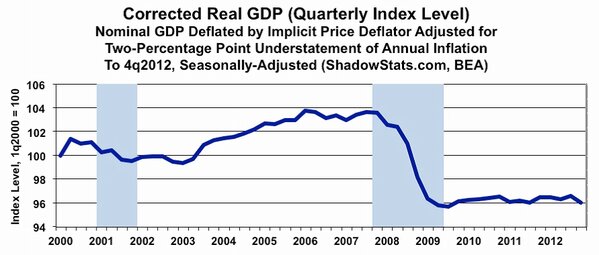
And this is where the fundamental misunderstanding in Turner's financial world lies, unless by "under control", he means "systematically engineered out of the figures".  The chart below shows the rate of inflation
  1.  As it used to be calculated
  2. At the kind of levels that would explain the behavior of the asset prices above.


Courtesy Shadowstats - inflation calculated the old way


If the world was a normal place, then gold bullion would continue to be in the same slump it endured for years and years.  But, things are not normal. Americans are stocking up on batteries, water, plastic sheeting and duct tape.  It is this fear that is behind the rise in gold bullion. And investing by fear usually ends as badly as investing by greed.  
We can tell you categorically, that the smart money who have been the recipients of this ongoing wealth transfer for the last decade, were not buying through "fear"; they were buying through knowledge of history and understanding the true causes, and this is also why to this day Turner fears that, which he does not understand.

These days he maintains that: (Source)
Read my books. I have consistently recommended a gold position – ideally of about 5% with consistent profit-taking to maintain that position. Had you followed this, you would been a happy person. I am. — Garth
However this is not apparent in any single article he has ever put onto the internet, that we can find, and his own weighting is also 1% according to the quote here
Garth Turner’s Investment Television airs Sundays on Global.  
Internet, garth.ca   - Editors's Note:  we are sure this show was pure gold


Attention All "Blog Dogs"

This project is staffed by a pack of ex-military Rottweilers who do not give a ****


With regards your comments thus far, it should also be noted that it takes much less time to chuckle and press delete, than for you to pour out your silly hearts typing such nonsense. 

We are willing to discuss the facts, data, dates, quotes and performance, but are every bit as disinterested in your emotional views as those of the Canadian realtors, there is no place for emotion in finance. 

Comment Policy:  Comments and/or arguments on content are welcomed, anything intelligent will be published, anything funny will be published, if you can manage both you are 100% in.

Otherwise, you are dealing with Gus-------->

..on comment moderation duty.

That is all.


Friday, January 11, 2013

Anti-Turner ETF - Theoretical Returns 2010 -2011

This  forum post is interesting, as a poster on there has laid out Turner's 2010 macro overview succinctly. 

From this we can analyse approximate returns on the immediate Anti-Turner trades and longer term holds. The ETF would only look to make specific trades in markets that are easily available to amateur traders through retail accounts in one form or another. Here is the whole list and we will break it down in more detail below

Re: Garth Turner: Buy Bank Preferreds not GICs

Postby BRIAN5000 » 23 Jan 2010 11:55
The world according to Garth- don't shoot the messenger.

Gold is in a bubble
Real estate is in a bubble
Mortgage rates have averaged 8% last 20 years
Don't use ETF's
Don't do-it-yourself you can't
Use TFIA's (tax free investment accounts) TFSA's
Use TFSA to income split with wife and kids (no explanation how to get it back from kids)
Use RRSP's borrow to catch up
Borrow at 2.25% to pay off higher debt
Use leverage to remove funds tax free from RRSP
Current bull market has about 10 months then sideways for ? Long time till normal
Oil is going to $100 soon and maybe $200 later
If 60% or more of your networth is in Real Estate its time to balance things out
Use tax advantaged investment vehicles, dividends and CG, dividend stocks are stable.
Invest in Global Growth outside of US except for a few multi nationals.

For retirement you want income and liquidity

What's going up
GDP
Inflation
Interest rates
Bond yields
Canadian dollar $1.10 - 1.15-1.20
Tax's
Equities
Energy
Commodities

What's going down
Gov't spending
Bond prices ( record amounts invested last few months)
Incomes
Car sales
Housing

1.  A subject that his been covered here in depth.

Gold is in a bubble - Gold price $1084 on 22 Jan 2010  Gold price 11 Jan 2013 approx $1650

ETF Trade 1 - WIN + 52% over 3 years. Continue to Hold until Turner starts buying


2. (Canadian) Real Estate - also discussed

Real estate is in a bubble
ETF Potentially profitable but NO TRADE 

Although cash rich investors could have flipped at least two houses in a rising market against Turner's call, but this is not one we could trade unfortunately.


3. "Mortgage rates are going up" - implies bond prices down, ETF long Bonds?

Mortgage rates have averaged 8% last 20 years ..and gone down steadily since this call
ETF Potentially profitable but NO TRADE 


Then we have some Canadian-specific advice and tax avoidance advice which we will not pass judgement on, it is only Turner's Macro-expertise specialist skills we are interested in directly fading.

4. Oil - this one we could have really worked with. 

Oil is going to $100 soon and maybe $200 later
ETF Trade - BEWARE TURNER ALSO BULLISH, Stay out & look for better entry.

As regular traders of crude oil futures this one is worth a closer look. Some idiot traders had been trading in the period up to this, buying at $70.00 and selling at $80.00 profit (1000 points) per contract as the market reached it's long term trend line each time.  Note the exact placement of Turner's call on the line. This is the true value of a quality contrarian indicator, because if a trader was leaning towards taking a long position at that point, and the contrarian indicator agrees with you, then you are simply wrong, so step aside and save your losses.


Traders who want to win consistently should always strive to not find themselves buying at the top of a decent run, but sometimes temptation can be strong, however in this instance the ATETF traders would have been saved from the dumb money trap and being stopped out for a potential 5% loss, plus still get the opportunity to buy at $70 again before the market actually took off properly for a $40+ run, minus of course all the previous top buyers, now just watching the run and nursing their losses. 

We cannot credit a $40 win  to the ETF here but had various idiot traders been aware of Turner's unique capabilities at the time, this is a potential $40,000 win or +40% account size in a solid 12 month run, for a 5% loss risk. 


And last & quite a find is a CAD currency call. 

Canadian dollar $1.10 - 1.15-1.20
 ETF Trade - Wins & re-enters short at test of & close below "Turner's Top" 


This is a thing of rare beauty, to be able to look at a chart and know as a virtual certainty (historical data entirely on your side) that Turner's bullish call will hold as the top,  and you even get to do it again the second time it when it comes back up for another look, before for the real move. 

These two trades, taken at 2% loss risk on a $100k account, would allow 2 contracts on trade 1, and 1 contract on trade 2, set by required stop size. 

Trade 1 profit = 2 x 7000 points  = $14,000 or + 14% on a 100k account

Trade 2 profit = 1 x 12000 points = $12k or + 12% on a 100k account. 

It should now be fairly apparent why some idiot traders are excited over the potential of fading Garth Turner on an ongoing basis, hands up who thought they were only joking about opening a PAMM yesterday?

We also harbor a strong suspicion that if Turner's "balanced portfolios" are indeed achieving 7-8% per annum, that Turner's role in things is primarily on the marketing / lead generation side, and whoever is in charge of the actual trading portfolio balancing there is probably using his skills exactly the same way we propose to.


Thursday, January 10, 2013

The Idiot's Guide To Wealth - Or Day Trading The Anti Turner Method

Garth Turner said a few weeks back that "Day Traders are idiots".  Well we've had a quick survey and apparently the feeling is completely mutual. However, as documented in the Anti-Turner ETF we feel his uncanny ability to top and bottom-tick markets (biased in the wrong direction) could provide a considerable edge for a trader.  

In the previous post "Fading Turner's Financial Advice", we took a theoretical longer term view based on Turner predicting further rises at the top, which we are confident will come to be known as "Turner's Top" in the fullness of time, however today idiot day traders made money directly from him. 

The chart below shows the original theoretical and imperfect entry, we could have banked 100 points on day two, but let it ride instead and were theoretically stopped out at  breakeven again earlier today. However "Turner's Top" really seemed like a good a place to bank some dumb money today, and so as the market hit the previous highs, some idiot traders shorted, as below.


This chart shows the 15 minute chart detailed (action) view, and how because of the high level of confidence in Turner's accuracy and timing, some idiot traders made 3000 points, in real life. After a few months of consistent profitability, some idiot traders might even be tempted to open up a PAMM and let the public invest in fading Garth Turner's financial results more directly.


Now if we could just get weekly direction calls on crude oil, EURUSD, GBPUSD & EURJPY we'd really be laughing.

Wednesday, January 9, 2013

The Power of the Modern Internet

UPDATE 10-Jan-2013  - Page One - see image bottom of page

Google is extraordinarily fast in 2013. It's almost mind-blowing complexity allows it be virtually indexing the whole internet in real-time these days. The results of which can be seen here, as this blog is a mere two weeks old today, and seems close to making Page One on Google for "garth turner greater fool" on Google.com 


Google even appears to considers it more relevant than www.garth.ca - his old site already, although as Turner has blocked access to search engines, that is probably to be expected. Only just above us on page one is his Wikipedia entry, so this seems quite promising at only the 2 week-old stage, it seems to show that a content-based strategy can be effective. 


So what can we expect in the way of keyword traffic when we get there? 


Not very much, unfortunately, and it seems to be a Canada-only phenomena. Much like the S&P, search interest peaked in 2007/2008 and been in a secular bear market ever since


It should also mean decent visibility on all of the more in-depth topics.


UPDATE 10-Jan-2013  - Page One 


These should probably go in here too, at least until Google update with some more *suggestions*


Garth Turner vs Marc Faber


Examining the evidence on financial credibility, and the differences of opinions between Garth Turner and Marc Faber on the future. The only thing we would add to this otherwise well presented video, is just how funny Garth Turner thinking that he is in any way contrarian, is

If anybody wonders why this motivates us, they should spare a thought for the thousands of people burnt very badly over the years by Turner's continued monetization of his "celeb" status over many years

For those not familiar with Marc Faber, here is his wiki entry http://en.wikipedia.org/wiki/Marc_Faber
No problem with citations from reliable sources there. Compare and contrast with Mr Turner's.

Marc Faber (born February 28, 1946) is a Swiss investor. Faber is publisher of the Gloom Boom & Doom Reportnewsletter and is the director of Marc Faber Ltd which acts as an investment advisor and fund manager.[1][2][3] Faber also serves as director or advisor of a number of investment funds that focus on emerging and frontier markets, including Leopard Capital’s Leopard Cambodia Fund and Leopard Sri Lanka Fund.[4]
Faber has a reputation for being a contrarian investor and has been called "Doctor Doom" for a number of years. 
Investment views 
Faber is credited for advising his clients to get out of the stock market before the October 1987 crash.[13] 
[Editor Note Garth was there also]
Faber predicted the rise of oil, precious metals, other commodities, emerging markets, and especially China in his book Tomorrow's Gold: Asia's Age of Discovery. He also correctly predicted the slide of the U.S. dollar since 2002[14] He stated that there are few value investments available, except for farmland and real estate in some emerging markets like Russia, Paraguay, and Uruguay.[8] He believed in early 2007 that a major market correction was "imminent." (Fox News, 2-2007); however, by 5/2007 he was saying that U.S. equities were moderately overvalued — less so than those of emerging markets.